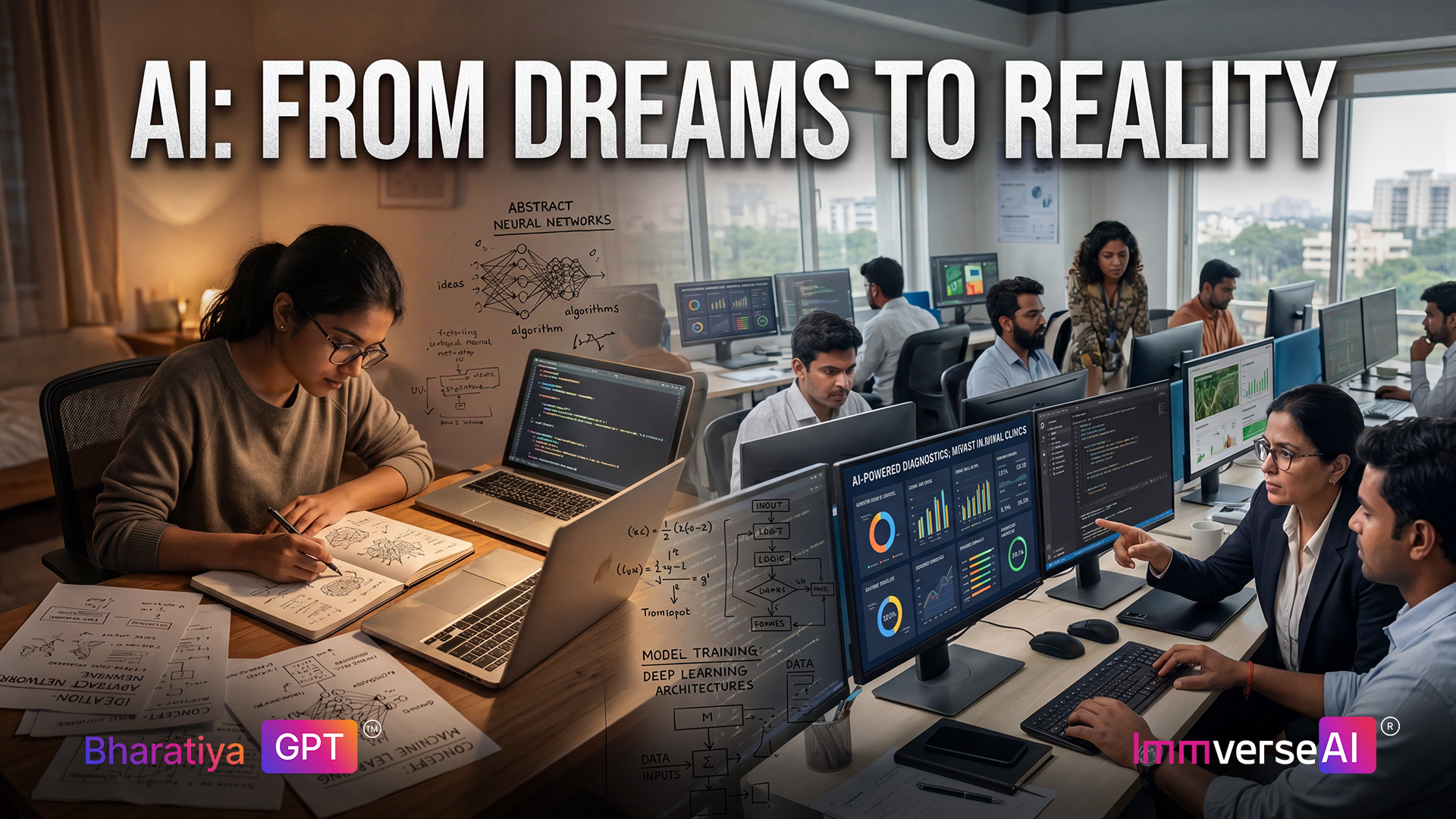
What if we told you that you can become immortal and live till eternity?
This concept is becoming a thrilling reality as we at ImmverseAI are working to preserve your essence through advanced Artificial Intelligence technology. We at ImmverseAI are here to encapsulate your personality traits in digital avatars that embody who you are. Mind you! These avatars don’t just represent you; they engage in meaningful conversations and provide guidance, making the dream of immortality tangible!
Now that we find ourselves in the golden age of AI, where incredible possibilities are unfolding every day, let’s take a journey through the history of AI to understand just how far we’ve come and the milestones that paved the way for today’s breakthroughs.
The Seeds of Imagination
If you believe that the idea of robots and AI originated with scientists, prepare to be amazed! It was actually the imaginative playwrights who first planted the seeds of this extraordinary concept. The journey of AI began in 1921, when Czech playwright Karel Čapek introduced the term ‘robot’ in his groundbreaking play ‘Rossum's Universal Robots’, igniting a global fascination with mechanized beings. Just a few years later, in 1929, Japanese professor Makoto Nishimura brought this visionary idea even closer to reality by building one of the earliest robots ‘Gakutensoku’ to life These early explorations laid the essential groundwork for what would grow into a revolutionary field, setting the stage for the significant milestones in AI development we enjoy today.
The Birth of AI
The 1950s marked a transformative decade in the history of artificial intelligence. In 1950, mathematician Alan Turing proposed the Turing Test to determine machine intelligence, setting foundational standards for the field. Just two years later, Arthur Samuel developed a Checkers program that could learn from its mistakes. In 1955, the term ‘Artificial Intelligence’ was officially born when John McCarthy organized a workshop at Dartmouth College.
an essential moment in the artificial intelligence timeline.
Growing Pains and Triumphs
The late 1950s and 1960s saw significant advancements, such as the introduction of ‘Unimate’, the first industrial robot, which began working at General Motors in 1961. However, the 1970s brought the ‘AI Winter’, a period marked by funding cuts. Despite this, innovative projects continued, like the ‘Stanford Cart’, one of the first autonomous vehicles, which navigated a room full of chairs autonomously in 1979. These achievements demonstrated the resilience of AI pioneers and innovators and set the stage for future artificial intelligence breakthroughs.
The AI Boom
The 1980s saw a revival in interest, known as the ‘AI Boom’. The first conference of the American Association for Artificial Intelligence in 1980 highlighted the growing enthusiasm for AI research. The Japanese government invested a staggering amount of $850 million in the Fifth Generation Computer project, aiming to create computers capable of thinking and communicating like humans.. Despite warnings of another downturn by 1984, the decade produced significant advancements, including Ernst Dickmann’s first robot car in 1986, further showcasing the impact of AI on society.
The AI Winter Returns
As predicted, the late 1980s brought about another AI Winter, characterized by reduced funding and interest. Many companies struggled, but the AI community continued to innovate. In 1988, Rollo Carpenter invented ‘Jabberwacky’, a chatbot designed for having engaging conversations with humans. By the early 1990s, renewed interest began to emerge, paving the way for a resurgence in AI development. This period illustrated the enduring human spirit and quest for technological advancement, marking key events in AI history.
The Rise of AI Agents
The 1990s marked a significant revival for AI, highlighted by IBM's Deep Blue defeating world chess champion Garry Kasparov in 1997. This victory proved that machines could surpass human intelligence in complex tasks, effectively raising the stakes in the ongoing debate of AI vs. human intelligence. As Artificial Intelligence began to integrate into daily life, products like Roomba, the robot vacuum cleaner, and IBM’s Watson, which famously won Jeopardy in 2011, showcased artificial intelligence milestones that changed everyday experiences.
The Age of Artificial General Intelligence
Today, we find ourselves in the Age of Artificial General Intelligence (AGI), marked by rapid advancements that blur the lines between human and machine capabilities. In 2012, Google researchers trained a neural network to recognize cats without labels, showcasing remarkable progress in machine learning. The introduction of humanoid robots like Sophia, capable of expressing emotions and engaging in conversation, exemplifies the evolution of AI. In 2024, ImmverseAI launched BharatiyaGPT’, a custom large language model trained on Indic datasets, highlighting diverse applications of AI in the 21st century.
What’s Next in the Story of AI?
As we look towards the future, the possibilities for AI seem limitless. Could it unlock more secrets of immortality, enhancing human life and extending our existence? The journey of AI invites us to reflect on our roles in this extraordinary narrative. With the potential to redefine what it means to be human, we stand at a crossroads, ready to shape the future of technology. The tale of AI is one of dreams and breakthroughs! So, as we continue to write this incredible story, one question remains: what chapter will you write in the unfolding narrative of artificial intelligence?
.png)
.png)
.png)