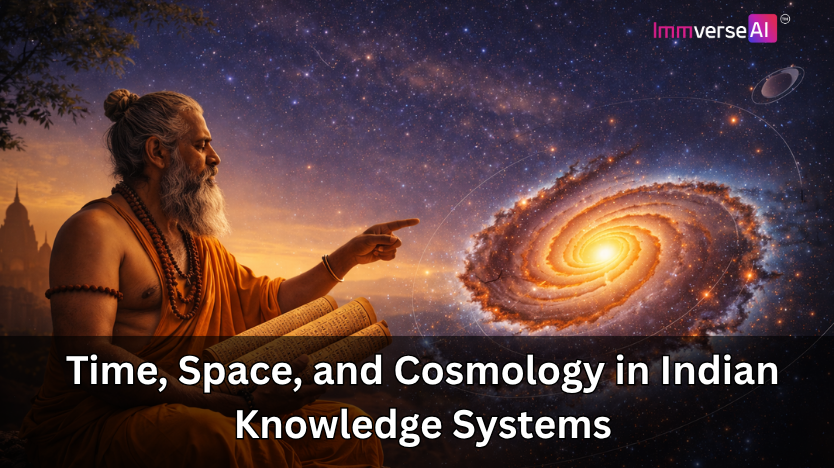
Long before modern telescopes, rockets, and labs existed, Indian thinkers were exploring the secrets of time, space, and the universe. Indian Knowledge Systems (IKS) contain deep insights into cosmology the study of the universe’s origin, structure, and destiny. These ideas continue to be relevant today and can help us bridge ancient wisdom with modern science.
Understanding Time: Cycles, Not Lines
In modern science, time is often thought of as a straight, continuous line. In Indian Knowledge Systems, time is cyclical. Ancient texts describe how the universe goes through massive repeating cycles of creation and dissolution. Terms like:
- Yuga
- Mahayuga
- Kalpa
appear in traditional literature to explain cycles that span billions of years.
Interestingly, this cyclical view of time parallels modern ideas like cosmic expansion, contraction, and the multiverse theory. Such parallels show how ancient Indian cosmology and modern physics can meet not by accident, but through deep observation and abstract thinking.
Space (Ākāśa): More Than Empty Nothingness
In Indian thought, space is called Ākāśa. Ākāśa is not just emptiness; it is the field in which everything exists. It is the medium for sound, energy, motion, and consciousness. Rather than being separate from matter, space is seen as the foundation of existence.
This idea connects beautifully with modern physics, where space is understood as a dynamic field full of energy and potential. Indian cosmology suggests that everything in the universe is interconnected through space, which aligns with discoveries in quantum physics and astrophysics.
Indian Cosmology: A Living and Infinite Universe
Indian Knowledge Systems view the universe as ever-changing and ever-alive. The universe is not random but follows a deep cosmic order called Rta. Some important features include:
- Multiple universes existing simultaneously
- Cycles of birth and dissolution
- Connection between the inner world (human consciousness) and the outer universe
Ancient Indian astronomers like Aryabhata, Varahamihira, and Bhaskara studied stars, eclipses, planetary motion, and time measurement with great accuracy long before telescopes or modern instruments were developed.
The Human-Universe Connection
One of the most beautiful ideas in Indian cosmology is “Yatha Pinde Tatha Brahmande”, meaning “As is the microcosm, so is the macrocosm.” This means humans are not separate observers, we are active participants in the universe. Consciousness, mind, and matter are woven together, not separated.
This idea encourages us to explore not just the world outside, but the universe within.
Bringing Ancient Wisdom to the Modern World
In the digital age, ancient knowledge is being rediscovered and shared in new ways. One such modern tool is BharatiyaGPT, an advanced AI platform developed to preserve, digitize, and explore Indian civilizational knowledge. Through resources like BharatiyaGPT, users can:
- Access Indian cultural heritage in multiple languages
- Explore ancient texts on cosmology, philosophy, science, and more
- Ask AI about topics from Vedic wisdom to traditional astronomy
- Get insights grounded in Indian knowledge traditions
For example, the https://bharatiyagpt.ai/bharatvarsha portal provides powerful tools and datasets related to India’s history, cosmology, culture, and civilizational studies. BharatiyaGPT helps bridge ancient wisdom with modern technology, making traditional ideas easier to explore for students, researchers, and curious minds all over the world.
Why IKS Matters in the 21st Century
Today, scientists study black holes, dark matter, the big bang, and multiverses. These topics can seem very technical and distant from daily life. But Indian Knowledge Systems show us that human beings have been thinking deeply about these topics for thousands of years not only as science, but as meaningful reflections on existence.
Here’s why IKS still matters:
- Long-term thinking: Cyclical time teaches patience and perspective.
- Interconnected worldviews: Space and consciousness are parts of one whole.
- Ethical science: Knowledge is meant to benefit life, not just impress.
- Inner and outer harmony: Awareness of self and universe builds balanced living.
When combined with modern research, AI, and evidence-based science, IKS can deeped our understanding of the universe in ways that are both practical and meaningful.
Conclusion: A Universe With Meaning
Indian Knowledge Systems teach us that time and space are not just abstract dimensions, they are living realities. Ancient cosmology invites us to see the universe not as a void to be conquered, but as a dynamic, interconnected field of life and consciousness.
Platforms like BharatiyaGPT are helping bring these ideas into the modern world. By connecting ancient wisdom with modern tools, we can learn to explore the universe not only with instruments and equations, but with curiosity, depth, and a sense of wonder.
The study of time, space, and cosmology in Indian Knowledge Systems shows us a universe that is not distant but intimately connected to who we are.
.png)
.png)
.png)