
Today, Mathematics is often seen as formulas, calculators, exams, and complicated equations on classroom boards. Most of the students grow up fearing numbers rather than enjoying them.
But centuries ago in Bharat, mathematics looked very different.
It was poetic.
It was philosophical.
It was deeply connected with imagination and real life.
Long before modern education systems existed, Lilavati introduced India to a way of learning mathematics that was creative, interactive, and intellectually beautiful.
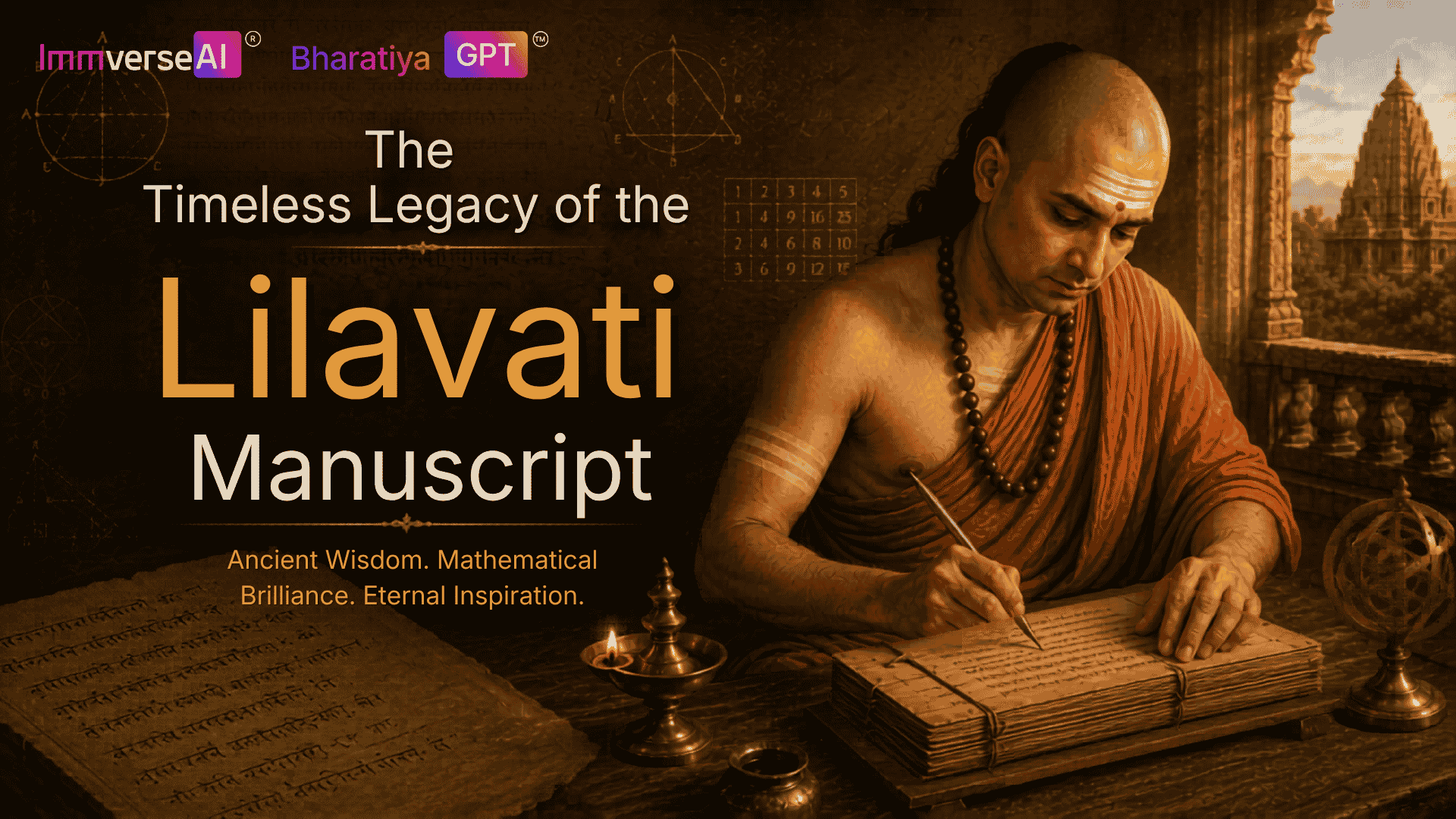
Written by Bhāskara II in the 12th century, Lilavati was not just a mathematics book. It was a reflection of how ancient Bharat approached knowledge itself, not as memorization, but as understanding.
What Was Lilavati?
Lilavati was a Sanskrit mathematical text that covered subjects such as:
- Arithmetic
- Algebra
- Geometry
- Fractions
- Measurements
- Logical problem-solving
But what truly made Lilavati extraordinary was how these concepts were taught.
Instead of dry theories and rigid equations, Bhāskara II explained mathematics through storytelling, poetic verses, and practical examples from everyday life.
A mathematical problem was not simply presented as a calculation.
It was presented as a thought.
This style of teaching encouraged curiosity rather than fear, something modern education systems are still trying to achieve today.
The Story Behind the Name
One of the most fascinating aspects of Lilavati is the story connected to its name.
According to popular belief, Lilavati was the daughter of Bhāskara II. Legend says that the book was written for her after a tragic incident altered her future. While historians continue to debate the historical accuracy of the story, it has become an emotional and cultural part of the manuscript’s legacy.
And perhaps that is what makes Lilavati timeless.
It combines logic with humanity.
Science with storytelling.
Knowledge with emotion.
The Importance of Lilavati Manuscripts
Before printing presses existed, knowledge survived through handwritten preservation.
Scholars carefully copied Lilavati onto:
- Palm leaves
- Handmade paper
- Traditional manuscripts
These handwritten copies are what we now call the Lilavati Manuscripts.
Over centuries, these manuscripts travelled across different regions of India and influenced generations of scholars and educators. They became proof that ancient Bharat possessed advanced mathematical thinking long before modern computational systems emerged.
Today, these manuscripts are preserved in museums, libraries, and research institutions because they represent more than mathematics.
They represent India’s intellectual heritage.
Ancient Knowledge in the Age of AI
Modern society often assumes innovation only belongs to the future.
But what if the future could also learn from the past?
At ImmverseAI, we believe ancient Indian knowledge systems should not remain hidden inside manuscripts and archives. They should be accessible, understandable, and relevant for today’s generation.
This vision is what drives BharatiyaGPT, an initiative designed to reconnect people with the wisdom of Bharat through artificial intelligence.
The Lilavati manuscripts are not just historical documents. They are examples of how India once taught logic, reasoning, and analytical thinking in deeply human ways. Through AI-powered platforms and cultural intelligence systems, ancient knowledge can now become interactive again.
Imagine learning ancient Indian mathematics not through memorization, but through conversations, storytelling, and contextual understanding powered by AI.
That is the bridge between heritage and technology we aim to build.
Why Lilavati Still Matters Today
Today, we use AI to solve problems in seconds.
But centuries ago, Bharat was already teaching people ‘how to think.’
That is what makes Lilavati special even now.
It did not treat mathematics as something cold or difficult. It turned learning into curiosity, imagination, and exploration.
And maybe that is exactly what modern education is missing.
The Lilavati manuscripts remind us that ancient India was not only rich in culture and spirituality, but also in science, logic, and innovation.
Now, through platforms like BharatiyaGPT by ImmverseAI, these knowledge systems can become accessible again, not locked inside archives, but brought back into conversations, learning, and everyday discovery.
Because some knowledge should not stay in the past.
Frequently Asked Questions (FAQs):
1. What is the Lilavati manuscript?
The Lilavati manuscript is an ancient Indian mathematical text written by Bhāskara II in the 12th century. It explains mathematical concepts through poetry, storytelling, and logical problems.
2. Why is Lilavati important in Indian history?
Lilavati is important because it showcases the advanced mathematical knowledge that existed in ancient Bharat long before modern education systems and technology.
4. Was Lilavati a real person?
According to popular legend, Lilavati was the daughter of Bhāskara II. While historians debate the accuracy of the story, it remains an important cultural part of the manuscript’s legacy.
5. Why are Lilavati manuscripts still relevant today?
The manuscripts remind us that learning can be creative, interactive, and engaging. They also highlight India’s contribution to mathematics, science, and education.
6. How is AI helping preserve ancient Indian knowledge?
Platforms like BharatiyaGPT by ImmverseAI aim to make ancient Indian knowledge systems easier to access, understand, and explore through artificial intelligence.
7. Where are Lilavati manuscripts preserved today?
Many Lilavati manuscripts are preserved in museums, libraries, universities, and research institutions across India as part of the country’s intellectual heritage.
.png)
.png)
.png)