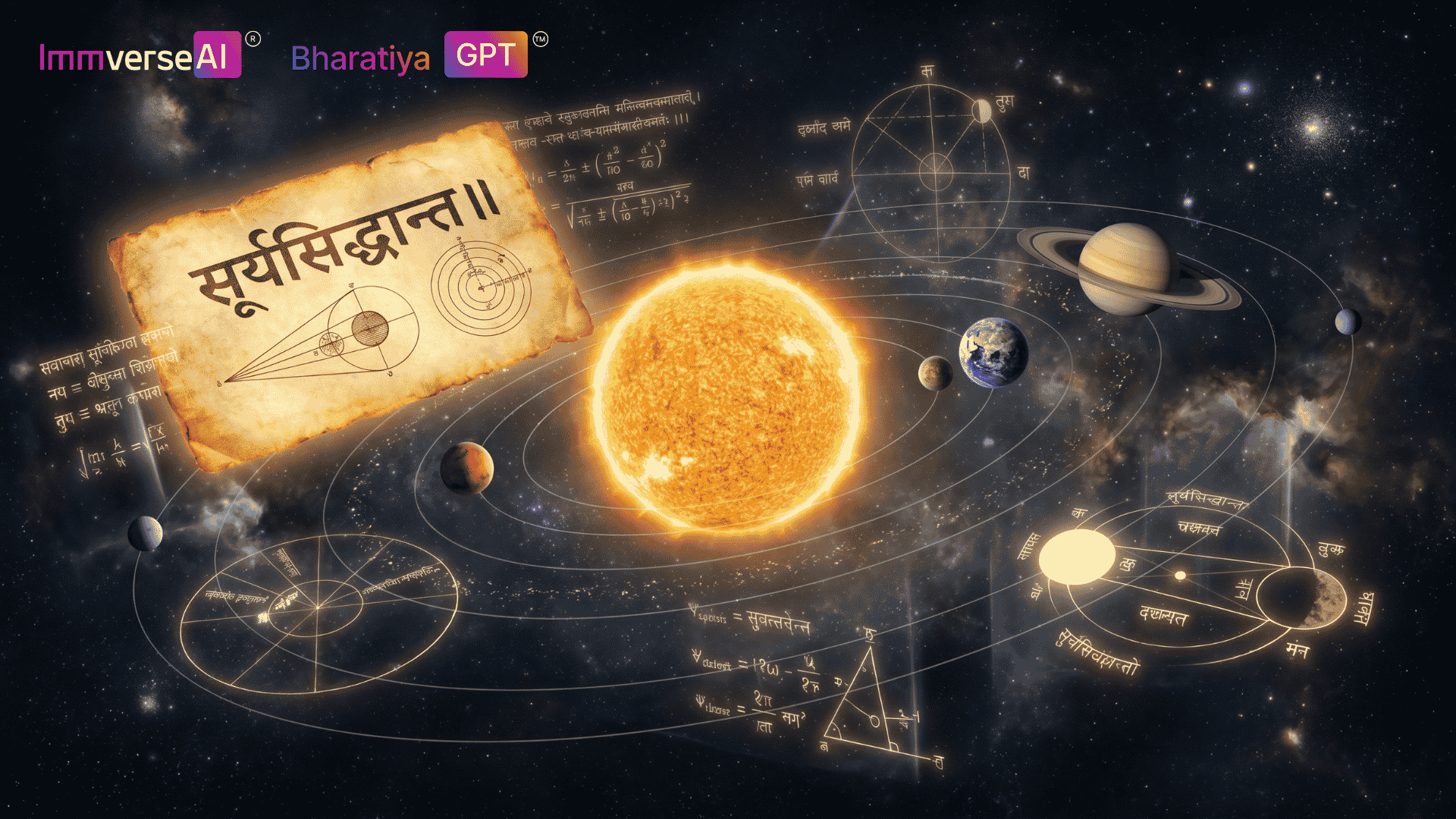

India's scientific heritage extends far beyond philosophy and spirituality. Among the greatest achievements of ancient Indian science is the Surya Siddhanta, a remarkable Sanskrit treatise on astronomy and mathematics that provided detailed explanations of planetary motion, eclipses, celestial calculations, and timekeeping centuries before modern astronomy emerged.
At BharatiyaGPT, we are dedicated to exploring India's rich civilizational knowledge, scientific discoveries, and intellectual traditions. Through our research-driven content, readers can discover how ancient Indian scholars contributed to fields such as astronomy, mathematics, medicine, philosophy, and engineering. If you enjoy learning about India's scientific heritage, be sure to explore our articles on Ancient Indian Mathematics
The Surya Siddhanta stands as a shining example of India's pursuit of knowledge and its deep understanding of the cosmos.
What is Surya Siddhanta?
The term Surya Siddhanta translates to "Doctrine of the Sun." It is one of the most influential astronomical texts of ancient India and serves as a foundational work in Indian astronomy.
According to traditional accounts, the knowledge contained within the text was revealed by Surya (the Sun God) to the legendary scholar Maya. While the surviving version is generally dated between the 4th and 5th centuries CE, scholars believe it preserves much older astronomical traditions developed over centuries.
The Surya Siddhanta presents mathematical methods for understanding celestial movements and became a key reference for generations of Indian astronomers.
Why is Surya Siddhanta Important?
The Surya Siddhanta combines astronomy, mathematics, geometry, and calendar science into a comprehensive scientific framework.
It enabled scholars to:
- Calculate planetary positions
- Predict solar and lunar eclipses
- Measure time accurately
- Create astronomical calendars
- Understand celestial mechanics
Its influence extended to renowned scholars such as Aryabhata, Varahamihira, Brahmagupta, and Bhaskara II.
Scientific Concepts Explained in Surya Siddhanta
Planetary Motion
The text provides sophisticated mathematical methods for calculating the movements of:
- Sun
- Moon
- Mercury
- Venus
- Mars
- Jupiter
- Saturn
These calculations allowed ancient astronomers to track celestial events with remarkable precision.
Scientific Explanation of Eclipses
The Surya Siddhanta offers a scientific explanation of eclipses:
- A solar eclipse occurs when the Moon passes between the Earth and the Sun.
- A lunar eclipse occurs when the Earth's shadow falls upon the Moon.
This understanding demonstrates the advanced astronomical knowledge possessed by ancient Indian scholars.
Measurement of Time
The text discusses detailed systems for measuring:
- Seconds
- Minutes
- Hours
- Days
- Months
- Years
- Yugas (cosmic cycles)
Many traditional Panchangs continue to use principles derived from these calculations.
Trigonometry and Mathematics
The Surya Siddhanta contains advanced mathematical concepts including:
- Sine functions
- Geometric calculations
- Circular measurements
- Angular computations
These innovations contributed significantly to the development of mathematical astronomy.
Remarkably Accurate Calculations
One of the most fascinating aspects of the Surya Siddhanta is the precision of its astronomical calculations.
Length of the Sidereal Year
Surya Siddhanta:
365.25636 days
Modern Astronomy:
365.25636 days
The remarkable closeness of these values highlights the observational and mathematical capabilities of ancient Indian astronomers.
Earth's Dimensions
The text also provides estimates of Earth's dimensions that are surprisingly close to modern scientific measurements.
Did Surya Siddhanta Mention Gravity?
Several verses suggest the existence of an attractive force that causes objects to fall toward Earth. While not a complete mathematical theory of gravitation, these ideas indicate that ancient Indian scholars recognized the concept of Earth's attractive force.
Influence on Indian Astronomy
For centuries, the Surya Siddhanta shaped:
- Panchang calculations
- Astronomical observations
- Navigation systems
- Calendar science
- Timekeeping methods
Its methods influenced some of India's greatest scientific minds and remained central to astronomical studies for generations.
Surya Siddhanta and India's Scientific Heritage
The Surya Siddhanta demonstrates that scientific inquiry, observation, and mathematical reasoning were deeply rooted in ancient Indian civilization. It serves as a powerful reminder that India's contribution to astronomy and mathematics extends back thousands of years.
Readers interested in exploring more ancient Indian scientific achievements can discover related topics on BharatiyaGPT, including:
- Ancient Indian Mathematics
- Aryabhata's Contributions
- Brahmagupta's Discoveries
- History of Indian Astronomy
- Panchang Science
- Bharatvarsha
- Vedic Knowledge Systems
Conclusion
The Surya Siddhanta remains one of the greatest achievements in the history of astronomy and mathematics. Its sophisticated treatment of planetary motion, eclipses, time measurement, and celestial calculations reveals a level of scientific understanding that was centuries ahead of its time.
At BharatiyaGPT, our mission is to bring such remarkable stories of India's scientific, cultural, and intellectual heritage to a global audience. By exploring ancient texts like the Surya Siddhanta, we gain a deeper appreciation for the knowledge systems that helped shape human civilization.
The legacy of the Surya Siddhanta continues to inspire historians, scientists, researchers, and curious minds around the world, standing as a testament to India's enduring pursuit of knowledge and discovery.
.png)
.png)
.png)