Introduction: A 2,000-Year-Old Blueprint for the Arts
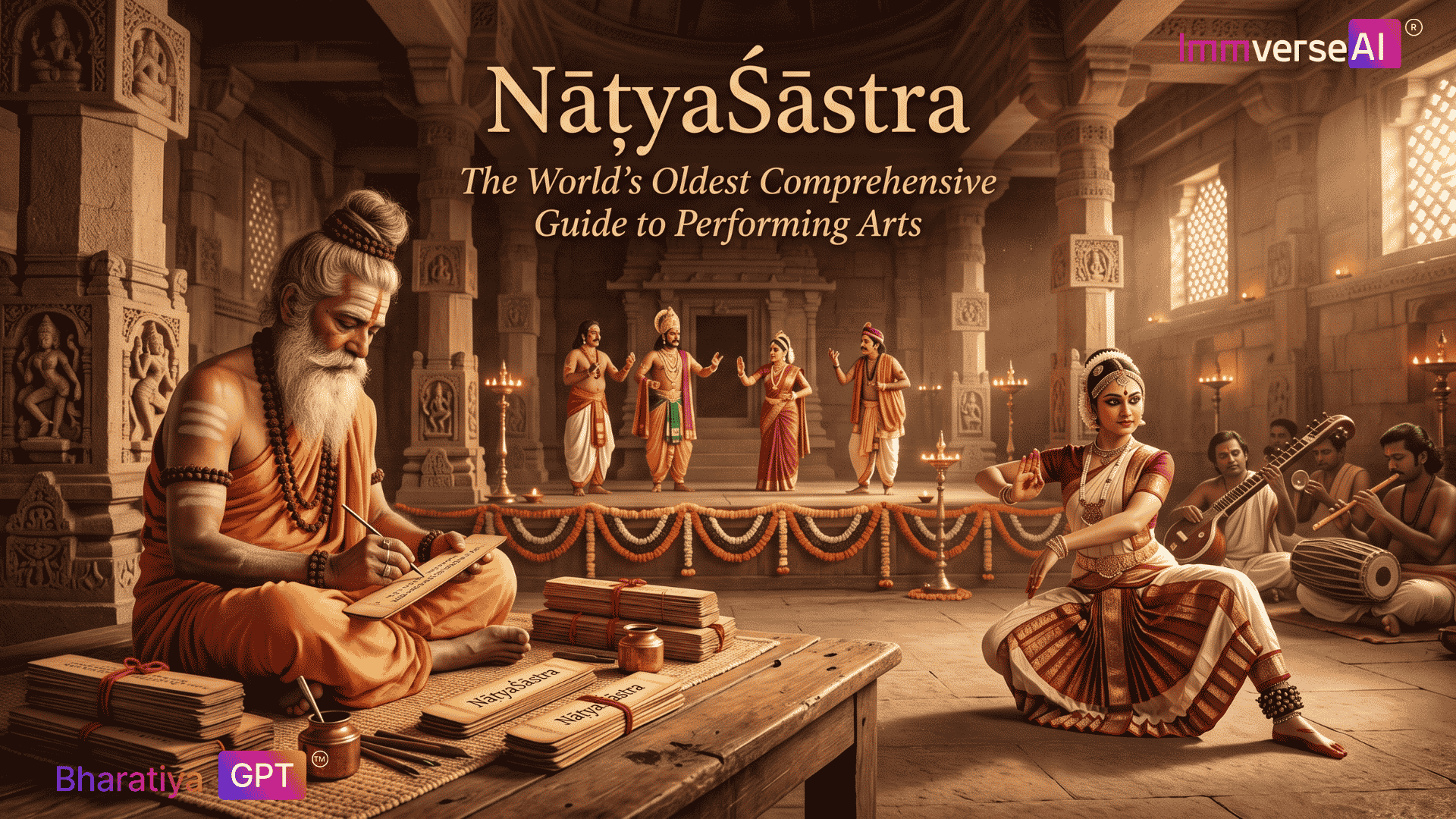
Long before "performing arts" became an academic discipline, an Indian sage named Bharata Muni sat down and wrote the rulebook for it.
That rulebook is the Nāṭyaśāstra - a Sanskrit treatise so detailed and far-reaching that scholars still consider it the world's oldest comprehensive guide to drama, dance, and music. It doesn't just describe performance; it explains why performance moves us, how an actor's smallest gesture can carry meaning, and how an entire audience can feel the same emotion at the same moment.
If you've ever wondered why a Bharatanāṭyam dancer's hand movements look so precise, or why classical Indian theatre feels emotionally layered rather than purely literal, the answer almost always traces back to this single text.
Let's explore what the Nāṭyaśāstra actually says, why it was written, and why it still matters today.
What Is the Nāṭyaśāstra?
The Nāṭyaśāstra (Sanskrit: नाट्यशास्त्र) is an encyclopedic Sanskrit text attributed to the sage Bharata Muni. The name itself comes from two Sanskrit roots: nāṭya (act, perform, represent) and śāstra (treatise, manual, set of rules). Put together, it literally means "the treatise on dramatic art."
It is often called the "Fifth Veda" - a title that signals just how seriously ancient Indian scholars treated performance. While the four traditional Vedas were considered too abstract for ordinary people to grasp easily, the Nāṭyaśāstra was designed as something everyone could see, hear, and feel.
Some key facts about the text:
- Author: Traditionally attributed to Bharata Muni, though many scholars believe "Bharata" may represent a school or lineage of scholar-artists rather than a single person
- Length: 36 chapters and roughly 6,000 verses
- Estimated date: Most scholars place its composition between 200 BCE and 200 CE, though its oral roots may stretch back even earlier
- Scope: Drama, dance, music, stagecraft, costume, makeup, character types, aesthetics, and audience psychology - all in one text
It's the reason scholars frequently describe it as part theatre manual, part philosophy of aesthetics, part mythological history, and part theology, all rolled into a single work.
The Origin Story: Why Was the Nāṭyaśāstra Written?
According to tradition, the Nāṭyaśāstra didn't begin as a practical manual - it began as a divine solution to a human problem.
The text opens with a group of sages approaching Bharata Muni with a concern: the four Vedas held profound wisdom, but they weren't accessible or easy for ordinary people to understand. The world needed something that could teach virtue, values, and emotional understanding without requiring years of Vedic study.
The solution, as the legend goes, was nāṭya - a fifth Veda created by Brahmā himself, drawing inspiration from all four existing Vedas:
| Element | Drawn From | Represents |
| Pāṭhya (text/recitation) | Ṛg Veda | The spoken or recited word |
| Gīta (song/music) | Sāma Veda | Music and melody |
| Abhinaya (acting/expression) | Yajur Veda | Gesture and physical expression |
| Rasa (aesthetic emotion) | Atharva Veda | The emotional experience of art |
This four-part foundation is why the Nāṭyaśāstra treats drama, dance, and music not as separate art forms, but as one integrated experience.
Inside the Text: What Do the 36 Chapters Actually Cover?
The Nāṭyaśāstra isn't a short philosophical essay - it's closer to an exhaustive technical manual. Its 36 chapters move through nearly every dimension of stagecraft, including:
- Dramatic composition and play structure — how to build plots, characters, and narrative arcs
- Stage and theatre construction — literal architectural guidelines for building a performance space
- Acting techniques and body movements — categorized in extraordinary physical detail
- Costumes and makeup (Āhārya) — visual storytelling through appearance
- Hand gestures, or mudrās — symbolic gestures used to communicate ideas, objects, and emotions without words
- Musical scales and instruments — the foundation of what would later become Indian classical rāga theory
- Character types — heroes, heroines, jesters, and the social/emotional roles they play
- Audience psychology — how a spectator processes and "tastes" emotion during a performance
Later chapters even cover specifics like the role of the vidūṣaka (a jester or comic character), regional dialects used in theatre, and "miscellaneous" closing guidance that ties the entire system together.
This depth is exactly why the Nāṭyaśāstra is described as the first authentic treatise on Indian classical music, dance, and drama — there simply wasn't anything this systematic before it.
The Heart of the Text: Rasa Theory
If the Nāṭyaśāstra has one single idea that changed art history, it's rasa theory, laid out primarily in Chapter 6.
What Is "Rasa"?
The Sanskrit word rasa literally means "essence," "taste," or "flavor." In an artistic context, it refers to the emotional experience an audience "tastes" while watching a performance - not just witnessing it, but feeling it.
Bharata Muni's famous Rasa Sūtra states it simply:
Rasa is produced from a combination of vibhāva (the determinants/situations), anubhāva (the consequent expressions), and vyabhicārī bhāva (transitory emotional states).
In plain language: a performer doesn't just say they're sad. The setting, the gestures, the facial expression, and the underlying emotional context all combine to create a feeling in the audience that goes far beyond words.
The Goal of Art, According to Bharata
Crucially, the Nāṭyaśāstra argues that entertainment is a side effect of performance, not its purpose. The real goal is to transport the audience into a heightened state of consciousness - to let them briefly step outside themselves and reflect on universal emotional and spiritual truths.
The Navarasas: The Nine Aesthetic Emotions
Bharata Muni originally described eight rasas. Centuries later, the influential Kashmiri philosopher Abhinavagupta (circa 1000 CE) added a ninth — śānta rasa (peace/tranquility) — completing what's now famously known as the Navarasas, or "nine emotions."
| Rasa (IAST) | Emotion | Associated Color |
| Śṛṅgāra | Love/romance | Light green or dark blue |
| Hāsya | Laughter/comedy | White |
| Raudra | Anger | Red |
| Karuṇā | Compassion/sorrow | Grey |
| Bībhatsa | Disgust | Blue |
| Bhayānaka | Fear | Black |
| Vīra | Heroism/courage | Saffron/orange |
| Adbhuta | Wonder | Yellow |
| Śānta | Peace/tranquility | White |
Śṛṅgāra rasa is often called the "mother of all rasas" because classical dancers believe nearly every other emotion can be expressed through its lens - love, after all, touches jealousy, longing, anger, and joy alike.
This system isn't just academic trivia - it's the emotional grammar that every classical Indian dancer, actor, and musician still studies today.
Abhinaya: The Art of Expression
Alongside rasa, the Nāṭyaśāstra introduces abhinaya - the technique of expressing meaning to an audience through performance. It's divided into four categories:
- Āṅgika abhinaya – expression through body movements and gestures
- Vācika abhinaya – expression through speech, dialogue, and voice
- Āhārya abhinaya – expression through costume, makeup, and ornamentation
- Sāttvika abhinaya – expression through genuine internal emotional states reflected outward
This is also where mudrās (symbolic hand gestures) come in. Specific hand positions - like patāka (representing a flag, or elements like water) or alapadma (often symbolizing a blooming flower) - allow a performer to communicate entire concepts silently. Anyone who has watched classical Indian dance and noticed how expressive a dancer's hands and eyes can be is witnessing Nāṭyaśāstra principles in direct action.
From Ancient Text to Modern Stage: The Nāṭyaśāstra's Living Legacy
It would be easy to assume a 2,000-year-old text is purely historical. It isn't. The Nāṭyaśāstra remains the direct theoretical foundation for nearly every major Indian classical dance form practiced today, including:
- Bharatanāṭyam
- Kathak
- Kathakaḻi
- Oḍiśī
- Kūcipūḍi
Dancers training in these forms still learn mudrās, abhinaya, and rasa expression rooted directly in Bharata's original framework. The text's influence also extends into Indian classical music theory, Sanskrit dramaturgy, and aesthetic philosophy more broadly — and it has even drawn comparisons from scholars to Aristotle's Poetics as a parallel foundational work on dramatic theory, despite the two emerging from entirely different cultural worlds.
The most significant commentary on the text, Abhinavabhāratī, written by the philosopher Abhinavagupta around the 10th–11th century, expanded and refined many of Bharata's original ideas - particularly rasa theory - and remains essential reading for serious scholars of Indian aesthetics even now.
Why the Nāṭyaśāstra Still Matters Today
In a world saturated with entertainment, the Nāṭyaśāstra offers something different: a framework for understanding why art moves us at all.
Its core insight that a performance succeeds not when it's technically flawless, but when it creates a genuine shared emotional experience between performer and audience — is just as relevant to a modern film, dance recital, or stage play as it was to a Sanskrit drama two millennia ago.
For students of Indian Knowledge Systems (IKS), classical dance, theatre, or aesthetics, the Nāṭyaśāstra isn't just a historical curiosity. It's a living system - one that continues to shape how millions of performers and viewers across India and the world experience the magic of performance.
Frequently Asked Questions
Who wrote the Nāṭyaśāstra? It is traditionally attributed to the sage Bharata Muni, though scholars debate whether "Bharata" represents one author or a lineage of scholar-artists.
How old is the Nāṭyaśāstra? Most scholars date its composition between 200 BCE and 200 CE, with oral traditions potentially extending earlier.
What are the Navarasas? The Navarasas are the nine principal aesthetic emotions described in the Nāṭyaśāstra's rasa theory: śṛṅgāra (love), hāsya (laughter), raudra (anger), karuṇā (compassion), bībhatsa (disgust), bhayānaka (fear), vīra (heroism), adbhuta (wonder), and śānta (peace).
How many chapters does the Nāṭyaśāstra have? The text is traditionally organized into 36 chapters comprising roughly 6,000 verses.
Which dance forms are influenced by the Nāṭyaśāstra? Bharatanāṭyam, Kathak, Kathakaḻi, Oḍiśī, and Kūcipūḍi all draw heavily on its principles of mudrā, abhinaya, and rasa.
.png)
.png)
.png)