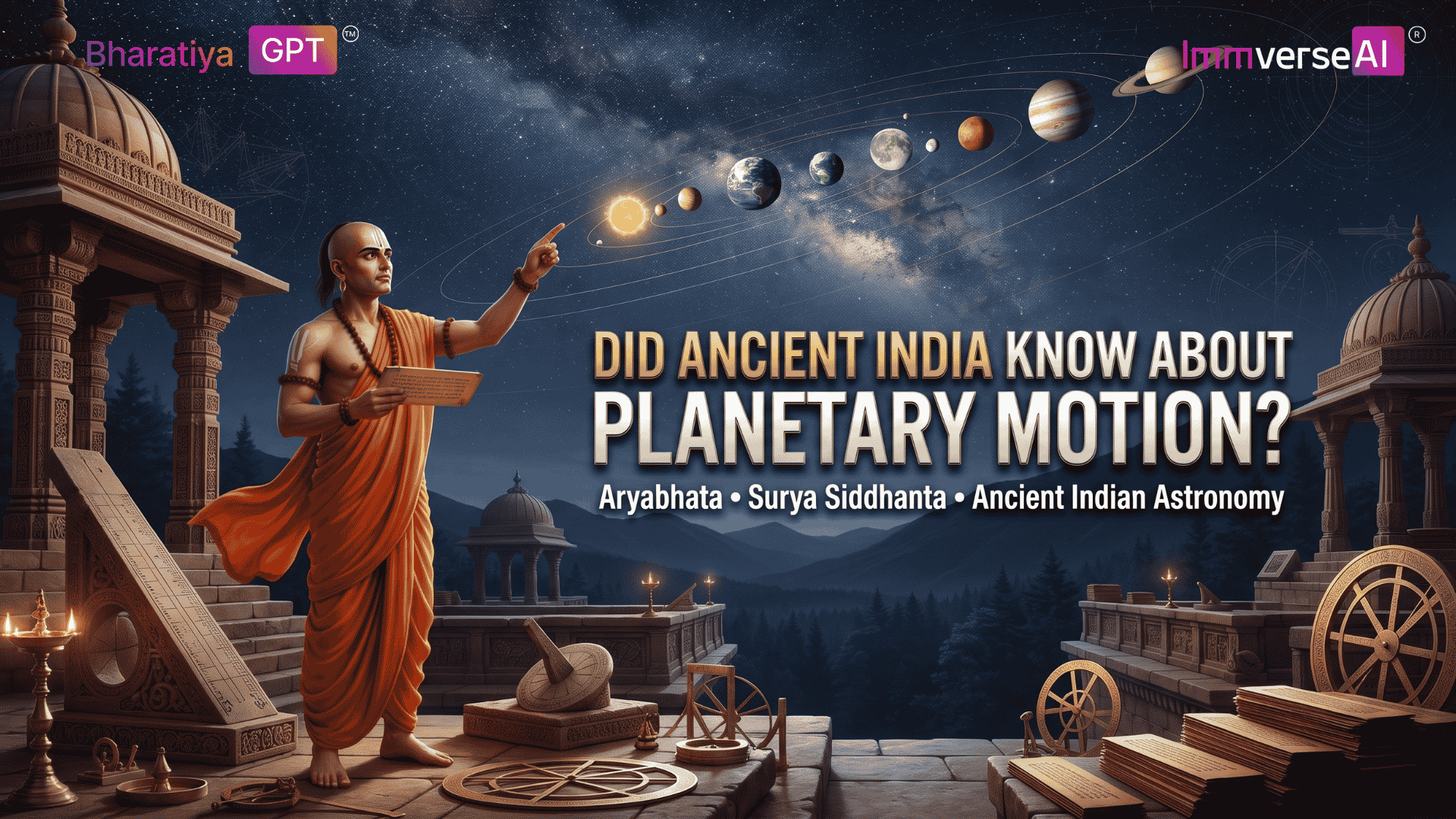
Long before telescopes existed, Indian astronomers were already tracking the planets and getting remarkably close to the right answers.
Thousands of years before satellites and space telescopes, people everywhere looked up and tried to make sense of the night sky. Most of us learn about this story through Greek astronomers, or later through Copernicus and Galileo. But ancient India was running its own parallel tradition of sky-watching called Jyotisha, or Khagol Shastra and it got surprisingly far using nothing but eyes, shadows, and mathematics.
So, did ancient India actually understand planetary motion? Short answer: yes, in real and specific ways though not in every way people sometimes claim online. Let's walk through what they actually figured out, who figured it out, and where the line between fact and myth really sits.
What Do We Mean by "Planetary Motion"?
Quick refresher before we dive in. Planetary motion covers things like:
- A planet orbiting the Sun
- A planet spinning on its own axis
- Planets shifting position against the background stars over weeks and months
- Retrograde motion — when a planet like Mars appears to slow down, stop, and move backward for a while
- Eclipses, when the Sun, Earth, and Moon line up just right
- The seasons, driven by Earth's tilt and orbit
Modern science explains all of this with gravity and orbital mechanics. Ancient Indian astronomers didn't have that toolkit — but they watched these same patterns closely enough, for long enough, to build models that actually predicted them.
Where It All Started: Jyotisha, India's Astronomical Tradition
Indian astronomy began as a practical tool, not a pure science experiment. It was one of the six Vedangas support disciplines for Vedic ritual built to answer questions like: When does the new year start? When's the next full moon? When should this ritual happen?
The earliest layer, the Vedanga Jyotisha, was mostly a calendar system. Over the centuries, though, this calendar-keeping tradition grew into something much closer to real mathematical astronomy. Generations of scholars worked on:
- Tracking planets and recording what they saw
- Building trigonometry-based calculation methods
- Predicting eclipses ahead of time
- Producing yearly almanacs (panchangas) still used in India today
- Measuring time with serious precision, using water clocks and shadow sticks
This work eventually crystallized into a series of landmark texts called the Siddhantas and that's where the real engineering of Indian astronomy lives.
The Surya Siddhanta: India's Astronomical Rulebook
The Surya Siddhanta is one of the most important of these texts. The version we have today took shape around the 4th–5th century CE though it's really a living tradition that later astronomers, including Bhāskara II, kept updating for centuries. Think of it less like a single book and more like an evolving reference manual.
It covers:
- How fast each planet moves on average
- How to predict solar and lunar eclipses
- The size and shape of the Earth
- A coordinate system for mapping the sky
- Time units ranging from split seconds to enormous cosmic cycles
- Trigonometry-based methods for doing all the math
Here's the genuinely impressive part: some of its calculated values land remarkably close to modern numbers not through luck, but through centuries of patient observation and correction.
| Quantity | Ancient Estimate (Surya Siddhanta) | Modern Value |
| Length of the year | ~365.2587 days | 365.2564 days |
| Length of a lunar month | Very close match | 29.53059 days |
| Earth's circumference | Same order of magnitude | ~40,075 km |
A quick honesty check, though: not everything in the text is "accurate" by modern standards. Some of its huge cosmic time cycles (yugas) are religious and symbolic figures, not measured data. What's genuinely worth admiring isn't every single number it's the underlying math: trigonometric tables, interpolation methods, and layered correction formulas, all built without a single telescope.
Aryabhata: The Astronomer Who Said Earth Spins
If one name anchors this story, it's Aryabhata (born 476 CE). He wrote the Aryabhatiya in 499 CE — at just 23 years old — while working in Kusumapura, near modern-day Patna, during the Gupta Empire.
He Said the Earth Rotates - and He Had a Great Analogy For It
Aryabhata argued that the daily "movement" of the stars across the sky isn't the stars moving at all — it's Earth spinning underneath them. His explanation has aged remarkably well: he compared it to sitting in a moving boat, where the riverbank seems to drift backward even though it's standing still.
That's a genuinely sharp piece of reasoning about relative motion, especially for the 5th century.
One important clarification: Aryabhata's overall model was still geocentric - Earth-centered. The Sun, Moon, and planets were all calculated as moving around a stationary Earth, using a system of two epicycles per planet (a smaller "manda" and a larger "shighra" cycle). A few historians have argued that traces of an older heliocentric model survive buried inside this system - but that's a genuinely contested claim among historians of science, not settled fact. The safe, accurate version: Aryabhata nailed Earth's rotation. He did not describe Earth orbiting the Sun.
He Replaced Mythology With Geometry for Eclipses
Before Aryabhata, eclipses were widely explained through the mythological figures Rahu and Ketu "swallowing" the Sun or Moon. Aryabhata offered a geometric alternative instead:
- Lunar eclipse → Earth's shadow falls on the Moon
- Solar eclipse → The Moon blocks sunlight from reaching Earth
He also stated that the Moon and planets don't produce their own light - they simply reflect sunlight. Both ideas are squarely in line with modern science.
He Tightened Up the Math
Aryabhata streamlined the older calculation methods considerably, cutting down the number of correction steps needed for inferior planets while improving accuracy. He also built an early sine table and used a clever alphabet-based numeral system to encode large astronomical constants compactly.
Brahmagupta: Sharpening the Tools
Brahmagupta (598–668 CE) worked in Bhillamala (today's Bhinmal, Rajasthan) and wrote the Brahmasphutasiddhanta in 628 CE. His contributions:
- More precise rules for predicting eclipse timing, duration, and magnitude
- Formal rules for zero and negative numbers - which directly powered better astronomical calculations
- Interpolation methods for estimating values between known data points
- Refinements to trigonometric calculation
Here's a fun trivia point for your readers: Brahmagupta's work was translated into Arabic in the 8th century and reached scholars in Baghdad, eventually influencing medieval Islamic - and later European - mathematics and astronomy.
Bhāskara II: Pushing the Models Further
Bhāskara II (1114–1185 CE) wrote the Siddhanta Shiromani, which refined planetary calculations even further. He worked on:
- More precise planetary longitude calculations
- The concept of instantaneous motion - a kind of early ancestor to calculus thinking
- More refined timekeeping
- A qualitative idea that the Earth has some kind of pull that makes objects fall toward it
Worth flagging clearly: this last point is not a theory of gravity in the Newtonian sense. It's an early physical intuition, not a mathematical law — there's no equation behind it the way there is with Newton's gravitational formula centuries later.
How Did They Crack Retrograde Motion?
Retrograde motion — when Mars or another planet appears to slow down, stop, and reverse direction in the sky — puzzled every ancient astronomical tradition, not just India's.
Using their two-epicycle system, Indian astronomers were able to:
- Reproduce the timing of these backward loops
- Predict when a planet would pause and reverse
- Build accurate almanacs years ahead of time
The real achievement wasn't spotting retrograde motion — anyone watching the sky long enough notices that. It's that they built working math to predict it, without knowing the actual cause (which is just Earth and the outer planets orbiting the Sun at different speeds).
What Tools Did They Actually Use?
No telescopes here — just clever, simple instruments:
- Gnomons (shadow sticks) to track the Sun's position through the year
- Sundials for daily timekeeping
- Water clocks (ghati yantra) for precise time intervals
- Armillary spheres for modeling the sky
- Long-term naked-eye tracking of planets against the fixed stars
One thing worth clearing up: the big stone observatories people often picture — like Jantar Mantar in Jaipur and Delhi are much later, built by Maharaja Jai Singh II in the 18th century. They're a continuation of this tradition, not evidence of giant observatories in the classical period.
The Math That Made It All Possible
None of this astronomy works without the math behind it. Indian scholars also developed:
- The decimal place-value number system, which later spread to the Islamic world and Europe
- Zero, with formal arithmetic rules (thanks, Brahmagupta)
- Sine tables and trigonometric methods, refined over generations
- Interpolation techniques for filling in gaps between known values
Centuries later, the Kerala school of astronomy and mathematics — founded by Madhava of Sangamagrama (c. 1340–1425) and continued by scholars like Nilakantha Somayaji — developed infinite series for trigonometric functions. This work anticipated some techniques associated with calculus roughly 200 years before Newton and Leibniz, though it stayed focused on astronomical calculation rather than growing into a general theory of calculus.
So, Did Ancient India Know the Earth Orbits the Sun?
This is the question that trips people up the most, so let's be precise.
Aryabhata's model was geocentric Earth stayed put while everything else moved around it. What he did establish clearly was that Earth rotates on its own axis. That's a real, distinct claim — separate from heliocentrism (Earth orbiting the Sun).
A handful of historians, most notably B. L. van der Waerden, have argued that parts of Aryabhata's system hint at an older heliocentric model buried underneath the geocentric framework. Other historians push back hard on that reading. Bottom line: there's no surviving text where Aryabhata, Brahmagupta, or any classical Indian astronomer says outright that Earth orbits the Sun.
The fair, evidence-backed claim: ancient Indian astronomers nailed Earth's rotation and built genuinely useful predictive models for eclipses and planetary positions — all within a geocentric system. That's impressive on its own. It doesn't need extra embellishment to be a real achievement.
Did This Knowledge Travel Beyond India?
Yes. Brahmagupta's work reached the Abbasid court in Baghdad by the 8th century and was translated into Arabic. From there, Indian trigonometric methods and the numeral system worked their way into Islamic astronomy — and later into medieval European mathematics, alongside the more commonly discussed Greek influence.
The Big Picture
Put it all together from the calendar-focused Vedanga Jyotisha, through the Siddhantas of Aryabhata, Brahmagupta, and Bhāskara II, to the Kerala school's calculus-adjacent work and you get a continuous, centuries-long tradition of trying to model the sky with math. The highlights:
- A working geocentric model that could predict eclipses and planetary positions
- Clear, correct recognition that Earth spins on its axis (Aryabhata)
- A geometric, shadow-based explanation for eclipses, replacing older mythology
- Real advances in trigonometry, including sine tables and infinite series
- The decimal system and rules for zero with consequences far beyond astronomy
- Centuries of practical calendar science supporting daily and ritual life
It wasn't one genius moment. It was generations of astronomers checking, correcting, and improving on what came before — which, honestly, is how most real science gets made.
Frequently Asked Questions
Did ancient India understand planetary motion? Yes. Using a two-epicycle system (manda and shighra), Indian astronomers tracked planetary movement over long periods and built models that could calculate positions and predict eclipses with practical accuracy.
Who first explained Earth's rotation in ancient India? Aryabhata, in the Aryabhatiya (499 CE), explained that the apparent motion of the stars comes from Earth spinning on its axis — not from the stars themselves moving.
Did ancient India know the Earth orbits the Sun? Not explicitly. Aryabhata's model was geocentric. He correctly identified Earth's rotation, which is different from heliocentrism. Some historians see hints of an older heliocentric framework in his math, but this is debated, not confirmed.
Which ancient Indian texts discuss planetary motion? The Surya Siddhanta and Aryabhatiya are the foundational texts, followed by Brahmagupta's Brahmasphutasiddhanta and Bhāskara II's Siddhanta Shiromani.
Did ancient India predict eclipses? Yes. Using shadow-based geometric models — instead of the older Rahu-Ketu mythology — Indian astronomers calculated eclipse timing and duration accurately enough for real-world calendar use.
What is the Kerala school of astronomy known for? Founded by Madhava of Sangamagrama in the 14th century, it developed infinite series for trigonometric functions used in astronomical calculations — work that anticipated some calculus techniques about two centuries before Newton and Leibniz.
.png)
.png)
.png)