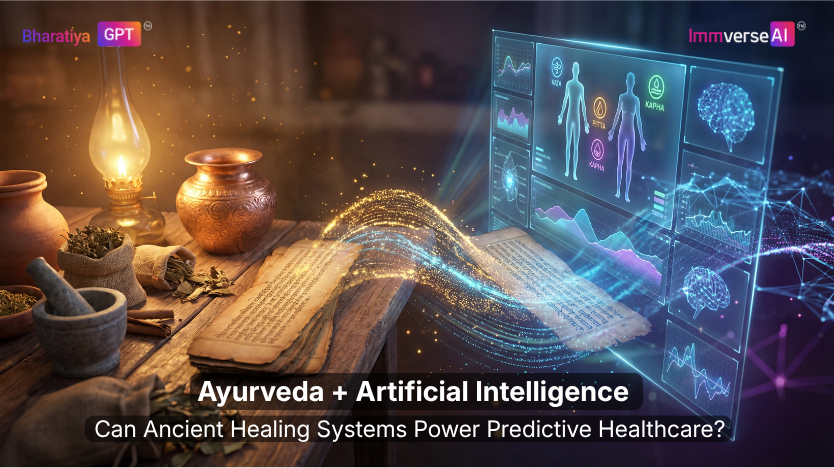
Healthcare across the world is moving in one clear direction from treatment to prevention. Instead of waiting for disease to appear, modern systems now aim to predict risks early and guide people toward healthier lifestyles.
Interestingly, this is not a new idea.
For thousands of years, Ayurveda has followed a preventive and personalized approach to health. Classical texts like the Charaka Samhita and the Sushruta Samhita describe how diet, sleep, emotions, climate, and daily habits influence long-term wellbeing.
Today, with Artificial Intelligence we have the opportunity to scale this wisdom like never before.
So the big question is:
Can Ayurveda + AI power the future of predictive healthcare?
What Makes Ayurveda Naturally Predictive?
Ayurveda does not wait for disease to fully develop. It studies:
- Your Prakriti (body constitution)
- Balance of Vata, Pitta, Kapha
- Seasonal changes (Ritucharya)
- Daily routine (Dinacharya)
- Food habits and digestion
Before symptoms appear, Ayurveda looks for early signs of imbalance.
Modern AI works in a similar way. It studies patterns in data to predict outcomes. When applied correctly, AI can:
- Detect lifestyle patterns that increase risk
- Identify early health signals
- Offer personalized wellness recommendations
- Monitor long-term changes over time
This is where tradition and technology naturally meet.
The Real Challenge: Making Ancient Knowledge Digital
Ayurvedic knowledge exists across thousands of Sanskrit and regional manuscripts. But much of it is:
- Unstructured
- Hard to search
- Written in ancient scripts
- Not easily accessible to young users
To make this knowledge usable in the AI era, it must be:
- Digitized
- Structured
- Interpreted responsibly
- Made conversational
This is where BharatiyaGPT plays a transformative role.
BharatiyaGPT: From Manuscripts to Conversational Intelligence
BharatiyaGPT is designed to convert Bharat’s classical knowledge into living, conversational AI systems.
Using advanced OCR, language models, and structured knowledge mapping, it enables users to ask contextual questions from traditional texts in a simple conversational way.
For example, users can ask:
- “What are early signs of Pitta imbalance?”
- “What kind of foods balance Vata during winter?”
- “What daily routine improves digestion naturally?”
Instead of searching through verses manually, the AI provides contextual responses grounded in classical sources.
This is not about replacing experts. It is about making structured knowledge accessible and searchable.
LokswasthyaGPT: AI for Community Health
Within BharatiyaGPT, there is a specialized health mode called LokswasthyaGPT.
LokswasthyaGPT focuses on preventive wellness and public health awareness rooted in Ayurvedic principles.
Its goal is simple:
- Provide accessible health guidance
- Promote preventive lifestyle awareness
- Support multilingual interaction
- Bridge traditional wisdom with digital access
In a country like India, where preventive healthcare awareness is still growing, AI-driven health education can make a real difference especially in rural and semi-urban communities.
Practical Use Cases of Ayurveda + AI
Here’s how this combination can shape predictive healthcare:
1. Prakriti-Based Risk Awareness
AI can help individuals understand their body type and possible tendencies.
2. Seasonal Health Guidance
Automated reminders aligned with Ayurvedic seasonal regimens.
3. Lifestyle Pattern Analysis
Tracking sleep, food, and stress patterns to detect imbalance.
4. Personalized Preventive Suggestions
Daily routines, diet suggestions, and wellness habits tailored to the user.
Importantly, such systems are designed to support awareness not replace medical consultation.
The Future: Integrating Tradition and Technology
Predictive healthcare is not just about advanced machines or expensive diagnostics. Sometimes, the answers lie in rediscovering structured wisdom that already existed.
Ayurveda provides the philosophy.
AI provides the scale.
Through platforms like BharatiyaGPT and LokswasthyaGPT, ancient knowledge is no longer limited to manuscripts it becomes interactive, multilingual, and accessible.
The future of healthcare may not be a battle between old and new.
It may be a powerful collaboration between civilizational intelligence and artificial intelligence guiding individuals toward healthier lives, before illness ever begins.
.png)
.png)
.png)