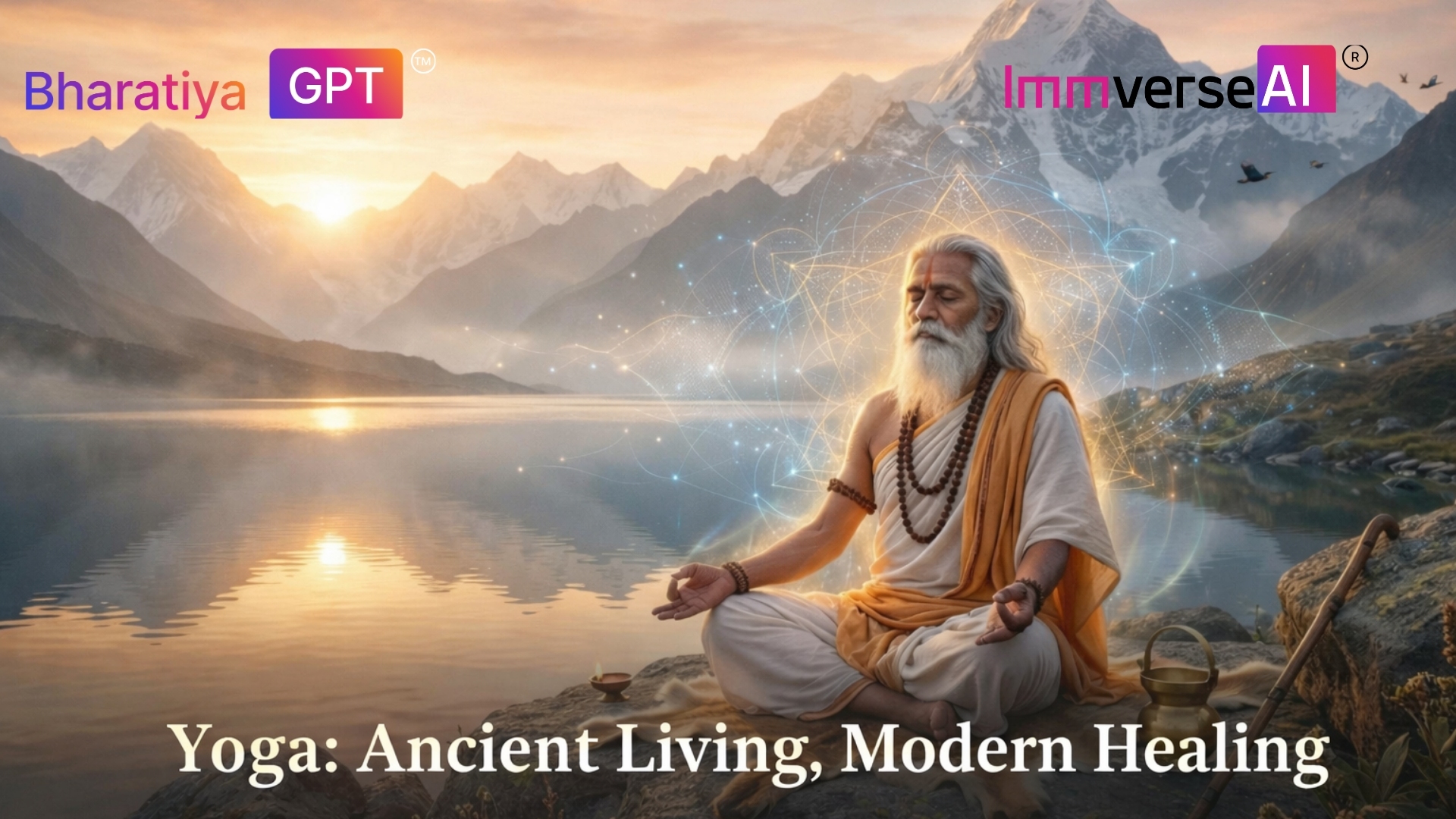
Hundreds of years ago, living in Bharat was all about being connected with nature, discipline, and living on our own. We were not dependent on machines, facilities, or technology. Even our routine was a form of physical movement - walking on foot, working on land, maintaining physical fitness, and living in harmony with nature.
People were not dependent on gyms, supplements, or medicine for living. However, they were living longer, stronger, and with fewer lifestyle diseases.
Why?
This is because their lifestyle was in complete harmony.
Today's society has become all about convenience. With technology available at all times, movement has decreased dramatically. Individuals are spending most of their time sitting in front of screens, with disturbed daily schedules and high levels of stress leading to increasing levels of health-related issues (stress, migraines, body pain, breathing issues, chronic fatigue, etc.).
While exercise in modern times may fulfill a need, Yoga has existed in India for thousands of years and is much more profound than modernity would suggest.
Origin and Philosophy of Yoga
Yoga is more than just a physical exercise; it is a method of living holistically, as yoga means "to join," and its goal is for the mind, body, and breath to work together.
Maharishis observed and meditated extensively before realizing that health is not simply a matter of being physically strong, but instead involves developing an inner balance. One major contributor to this knowledge was Maharishi Patanjali, who organized yoga into a systematic method via the Yoga Sutras.
The sages who created this knowledge/view yoga as something to do on a daily basis for the purpose of developing one’s awareness, stability, and long-term health, rather than to build muscles.
The Genesis: Who Invented Yoga?
Yoga does not have a "human" inventor, according to the lore of the Yogis. The "inventor" of Yoga, according to them, was Adiyogi, or the first yogi, and that "inventor" was none other than Bhagwan Shiva.
The Transmission: Thousands of years ago, on the shores of Lake Kantisarovar, in the Himalayas, Adiyogi, or the first yogi, and Bhagawan Shiva, transmitted his divine knowledge to the Saptarishis, or the Seven Sages.
The Diffusion: The Seven Sages then traveled to all the corners of the world, including Asia, America, Africa, and the Middle East, carrying the "seeds" of the yogic science.
The Codification: While the "science" of yoga was "gifted" by Adiyogi, or the first yogi, it was "codified" by Maharishi Patanjali in the form of the "Yoga Sutras." While he did not "invent" yoga, he "codified" it in the Ashtanga (Eight-Fold Path) - which made it accessible to every human being.
The Sage’s Perspective: Why Yoga?
The sages (wise seers) have always believed that the human body is a small copy of (or, probably more accurately, an extension of) the universe. The ancient sages' perspective was that disconnection causes all suffering; They believed that one of the purposes of Yoga (the ancient Maharishis) is to create Chitta-Vritti-Nirodha, stopping the spinning whirlpools of the mind; a good analogy for this is to think of the earth's oceans. Yoga is practiced by ancient sages to attain Samadhi, or a state where one experiences total dissolution with all that exists. Samadhi is the last stage of yoga, where you develop the ability to use the breath and physically position the body in such a way as to create harmony between mind and body.
Exploring the Many Aspects of Yoga
These days, people think of Yoga as a way to stretch or get fit. Yoga really is so much more than that. Yoga includes things like
- Asanas, which are postures that help make the body strong and straight
- Pranayama, which is about breathing to control energy and calm the mind
- Dhyana, which is meditation to help improve focus and awareness
- Yamas and Niyamas, which are ways of living that are ethical and disciplined
- Yoga is a complete system that helps people live a healthy life for a long time.
Health Benefits of Yoga
Yoga affects the body, mind, and feelings. The good things about Yoga can be seen, and they last for a long time.
- Yoga Makes The Body Healthy
- It makes the body flexible and strong
- It helps people stand up straight and feel good
- It gives people energy and helps them not get sick
2. Yoga Helps People Feel Good
- It reduces stress and anxiety
- It helps people focus and think clearly
- It makes people feel more stable and happy
3. Yoga Helps Prevent People From Getting Sick
If people do Yoga regularly, it can help stop them from getting sick with things like
- Hypertension
- Diabetes
- Obesity
- Heart problems
Yoga does this by making the blood flow better, balancing the hormones, and reducing stress. So Yoga is, like, a way to keep the body healthy.
Bridging the Gap: YogaGPT by BharatiyaGPT
At ImmverseAI, we think that ancient wisdom should not be confined to old books in a library. It is in this context that we came up with YogaGPT, a special version of BharatiyaGPT.
Inside YogaGPT, you can discover the depths of Yogic Science. These are the key points about the role of YogaGPT in bridging you to your roots:
- Ancient wisdom should not be lost to the past. As responsible Indians, it is our duty to preserve the remaining knowledge and make it accessible to all - we've created YogaGPT (as a special feature of BharatiyaGPT) that gives you access to the richness of yogic science and connects you back to your roots.
- You receive answers that reconnect you with the roots of yoga (Jaden) and go well beyond mere physical exercises.
- Yoga GPT serves as your digital Guru, helping you understand the philosophy, ethics, and choices of lifestyle the sages prescribed to improve your evolution as a human being.
- It takes what many would find to be complex Sanskrit verses from texts such as the Yoga Vashisthayam or Gheranda Samhita and simplifies them to have an easier understanding and to apply them in their daily lives.
Conclusion
"Yoga is the eternal gift of Bharat to the world - a science of living that begins with the body but ends in the soul." We are ensuring that the light of this knowledge never fades by marrying the discipline of the ancient Rishis with the precision of AI through YogaGPT. It is time to step onto the mat, not just for a better body, but for a higher state of being.
.png)
.png)
.png)