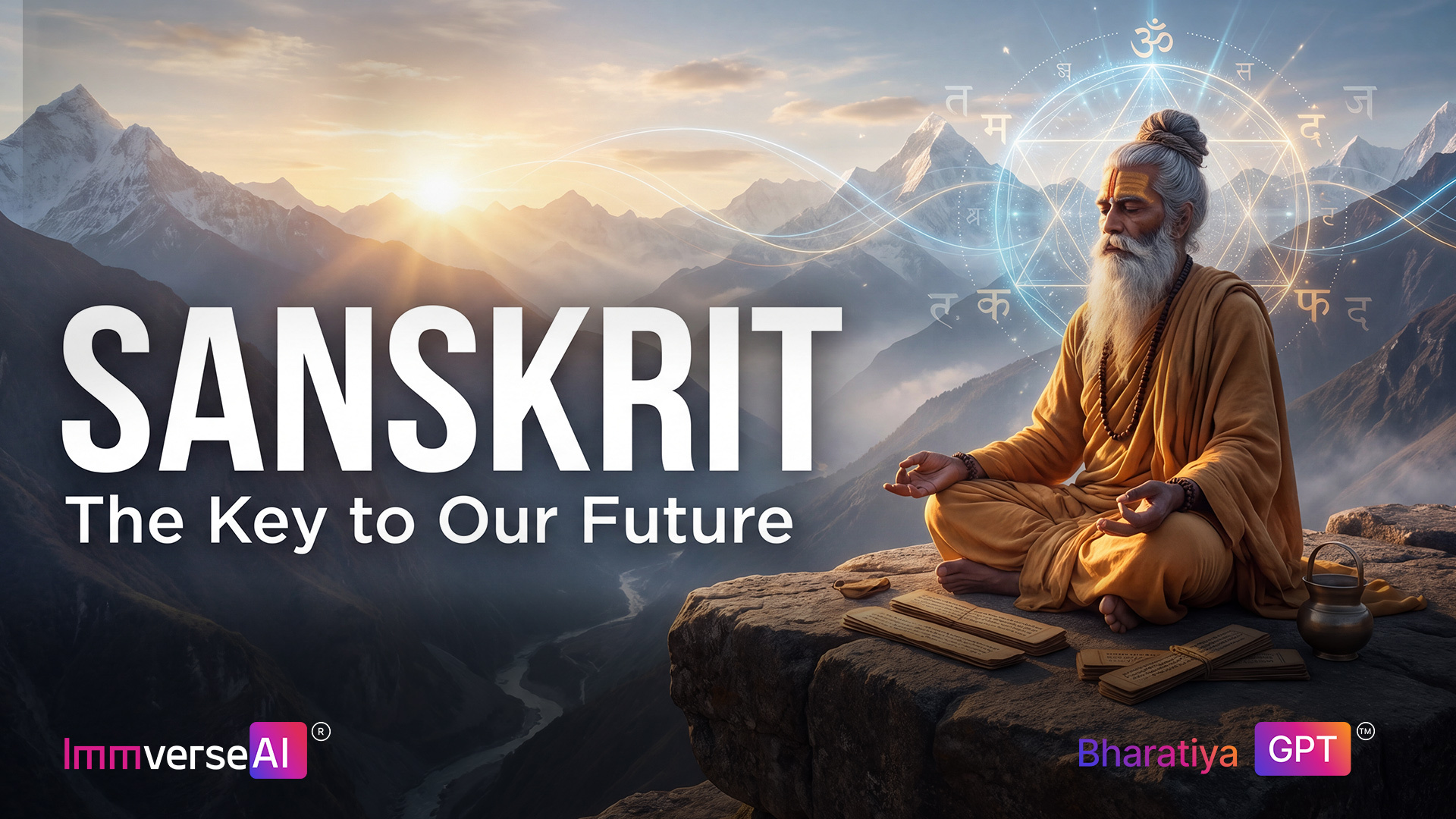

The Timeless Resonance: Why Sanskrit is the Key to Our Future
Sanskrit has been described as one of the most beautiful, structured, and meaningful languages in the world. It employs clear articulation, precise vocabulary, and fluid construction. Unlike many contemporary languages, it can be said that one does not merely speak but experiences when communicating using Sanskrit. Each term has a vast reservoir of meaning, while each phrase is joined together with logic and harmony.
But today, a question comes up:
Is Sanskrit for religious and spiritual books?
The answer is very simple:
No, Sanskrit is far more than that!
It is a language that not only holds the science and knowledge of the past but is also a tool for the present and the future!
The Beauty of a "Perfected" Language:
Samskrit itself means "refined" or "perfected." It is a language that has not evolved randomly over the ages like other languages. It has been designed by ancient grammarians like Maharshi Panini in a scientific manner. It is a language in which every sound is of a special vibration and every word is of a special root. When you utter Sanskrit words, you are not just communicating; you are becoming a part of a resonance that has been occurring for the last thousand years or so.
Beyond Rituals: Is it Just a Religious Language?
Sanskrit is often misunderstood to be a language of religious rituals. Although it is the soul of Indian spirituality, it has been the language of the intellectual class. Think of Sanskrit as the "Silicon Valley coding language" of the ancient world. Just as English is the international language of business today, Sanskrit has been the international language of in-depth research from Southeast Asia to Central Asia. It has not been chosen for its "holiness"; it has been chosen for its precision in recording data.
The Origin of Sanskrit: A Language Created with Precision
Sanskrit is really old. It is one of the languages that people have been speaking. The great scholar Panini worked hard to make sure Sanskrit was structured and organized. People are still learning from his work on grammar today.
What makes Sanskrit a language apart from all others is:
- It follows a set of grammatical rules
- Words are created in a logical way from sounds (dhatus)
- Sentences can be formed in a logical yet precise way
This makes Sanskrit comparable to modern computer languages, in which rules and structure are of prime importance. This makes Sanskrit not just one of the earliest languages in recorded history but a language of great relevance in today’s technology-savvy world.
The Treasure Chest of Knowledge
Not only did our ancestors write prayers, but they also wrote manuals on living. Scientists, mathematicians, and medical experts chose the Sanskrit language to impart their “theses” to the world because the grammar of the language promised that the meaning would not be distorted with time.
Mathematics & Astronomy (Lilavati): It was written by Bhaskaracharya a long time ago, before we had calculators. He wrote about systems, algebra, and geometry in a way that is easy to understand. He used poetry to explain these things.
Medicine: The “Sushrut Samhita” contains detailed descriptions of surgical procedures, including rhinoplasty, performed thousands of years ago.
Architecture: This is a specialized text on houses, cities, and the “Vastu Shastra” of temples.
Economics: The “Arthashastram” is the masterpiece of the famous Chanakya on economics, which is still relevant to management students.
Psychology & Wellness: The “Yog Sutras” by Patanjali is the guide to mastering the human mind and achieving focus - it is the “user manual” for the brain.
Why Learning Sanskrit is Important Today
1. Access to Original Knowledge
By studying Sanskrit, we can read the original texts written in Sanskrit. Thus, we can understand the original meaning of those texts without depending on translations, which sometimes have different meanings from the original texts.
2. Improves Brain Power
Sanskrit boosts memory, attention span, and reasoning ability. The linguistic structure of the language enables the brain to think clearly and systematically.
3. Builds Cultural Awareness
For students and parents, learning Sanskrit creates a connection to our culture. It helps us understand where we come from and what our ancestors knew. Our ancestors shared a lot of wisdom with us and Sanskrit helps us understand this wisdom.
4. Relevance in Modern Technology
The exactness of Sanskrit's structure makes it significant to many areas, such as Artificial Intelligence and Language Processing. There are many scholars and experts in various fields who believe that Sanskrit has a significant place to contribute to future technologies.
5. Develops Better Communication
Sanskrit can help us communicate better. By learning Sanskrit, students can also develop better communication skills in other languages.
Why Learning Sanskrit Matters Today
For students and parents, the benefits of Sanskrit are really good for you in two ways: they help your brain. They help you understand your culture.
Brain Development: When you learn Sanskrit shlokas by heart, it can actually make some parts of your brain bigger. These are the parts that help you remember things and see pictures in your mind.
Root Productivity: The majority of Indian and Indo-European languages (including Latin or Greek) contain some elements from the English language, so by learning Sanskrit, it will be much easier for you to learn other languages.
Logical Thinking: The grammar of Sanskrit is as logical as computer programming. Sanskrit teaches you to think in a logical and methodical way, which is really good for your mind.
Decoding the Future: The Role of BharatiyaGPT
The challenge we face today is that a lot of knowledge is locked away. Many old manuscripts are still not read because a few people can understand the difficult grammar of some subjects.
BharatiyaGPT is like a key that helps unlock this knowledge. By using artificial intelligence
- It supports scientists and students by showing them old solutions to new problems, like building sustainable homes or making medicine from herbs.
- It preserves our heritage by making sure that the ideas of our ancestors are not old relics but useful tools for building a strong future with BharatiyaGPT leading the way and making the most of BharatiyaGPT.
In conclusion: Our Legacy, Our Responsibility
Sanskrit is not a language of the past; it is a language of the timeless. It is a bridge that connects the intuition of our ancestors with the technology of our future. For a student, studying Sanskrit is like acquiring a superpower – the power to access a treasure chest of wisdom that can add strength to his or her career and character.
As we keep moving into the age, we should not forget about our best asset. When we learn Sanskrit, we are not just thinking about where we came from. We are also making a way for where we're going. We are making sure that Sanskrit, our legacy, is still with us, and it is still our responsibility.
Frequently Asked Questions (FAQ)
1- What is Sanskrit?
Sanskrit is an ancient Indian language known for its precise grammar and logical structure.
2 -How can beginners start learning Sanskrit?
Beginners can start with simple words, shlokas, and guided online tools.
3- Is Sanskrit only used for religious texts?
No, Sanskrit is used in science, mathematics, medicine, and philosophy as well.
4-What subjects are written in Sanskrit texts?
Sanskrit texts cover math, medicine, economics, yoga, and astronomy.
5-Why is Sanskrit called a perfected language?
Sanskrit is called perfected because it follows a highly systematic and refined structure.
.png)
.png)
.png)