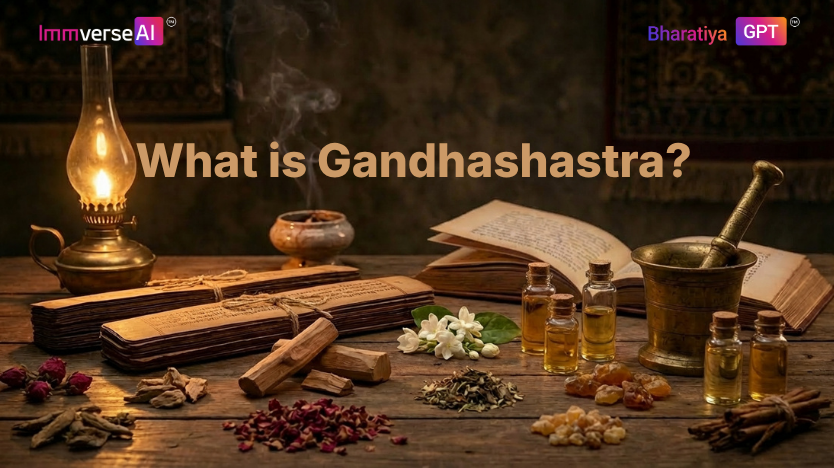

For thousands of years, fragrance has played a powerful role in human culture. From temples and rituals to medicine and personal wellness, scents have shaped how people experience the world. In ancient India, this knowledge was developed into a sophisticated discipline known as Gandhashastra.
Gandhashastra is the traditional Indian science of fragrances, perfumes, and aromatic preparations. The term comes from the Sanskrit words gandha (fragrance) and shastra (science or systematic knowledge). It describes how aromatic substances are extracted, blended, and used in cosmetics, rituals, medicine, and daily life.
Today, as interest grows in natural wellness, aromatherapy, and traditional knowledge systems, Gandhashastra is gaining renewed attention. With modern technologies like AI, ancient fragrance knowledge is now being rediscovered and made accessible again.
The Origins of Gandhashastra in Ancient India
The use of fragrance in India goes back to the Vedic period, where aromatic substances like sandalwood, camphor, and herbs were used in rituals, medicine, and personal care. Ancient texts such as the Vedas, epics, and classical treatises frequently mention fragrances as part of daily life and spiritual practices.
Over time, Indian scholars and artisans developed systematic knowledge about fragrances, including:
- Identifying aromatic plants and materials
- Extracting fragrance oils and essences
- Blending scents into perfumes and cosmetics
- Using fragrance in rituals and health practices
By the classical period, perfumery had become both an art and a science, requiring deep knowledge of plants, extraction techniques, and scent combinations.
Gandhashastra: More Than Just Perfumes
Many people assume Gandhashastra is only about making perfumes. In reality, it covered a wide range of fragrant products used in ancient India.
These included:
- Scented oils for body and hair
- Fragrant water for bathing
- Incense and ritual fragrances
- Herbal cosmetics
- Aromatic powders for clothing
- Mouth fresheners and scented tooth sticks
Ancient texts describe multiple methods for preparing these aromatic substances using natural ingredients such as flowers, woods, roots, resins, and herbs.
For example, scholars identified categories of fragrant materials including:
- Flowers
- Leaves
- Fruits
- Bark
- Wood
- Roots
- Plant resins
- Organic aromatic substances
This classification shows the scientific observation and experimentation involved in ancient Indian fragrance knowledge.
Advanced Fragrance Formulations in Classical Texts
One of the most fascinating aspects of Gandhashastra is the complex fragrance formulations described in ancient texts.
The famous scholar Varahamihira wrote about perfume blending in the text Brihat Samhita. In one chapter called Gandhayukti, he described dozens of aromatic substances and explained how different combinations could produce thousands of unique perfumes.
Later texts such as Gandhasara went even further, detailing complex methods for blending, intensifying, and preserving fragrances. These treatises show that ancient Indian perfumery involved careful experimentation and mathematical combinations of ingredients.
Cultural and Spiritual Importance of Fragrance
In Indian tradition, fragrance was not just about beauty or luxury. It also had cultural, spiritual, and medicinal significance.
Fragrances were used in:
- Temple rituals and offerings
- Meditation and spiritual practices
- Ayurvedic healing
- Royal courts and social ceremonies
- Personal grooming and hygiene
Certain fragrances were believed to influence mood, mental clarity, and emotional balance. this idea is similar to modern research on aromatherapy and sensory neuroscience, where scent is known to affect emotions and memory.
The subtleties related to perfumery include its novel use, like personalised perfumes, integral perfumes, the effect of perfumes on emotions, and the use of permutation & combination for the preparation of products
The underlying chemistry in the preparation of artificial Raw material.
Reviving Gandhashastra Through Artificial Intelligence
Today, much of the knowledge about Gandhashastra is still hidden in ancient manuscripts written in Sanskrit and other Indic scripts. These manuscripts are difficult to access, interpret, and study.
This is where modern technology is playing a transformative role.
Platforms like BharatiyaGPT are working to convert classical manuscripts into conversational AI systems. The goal is to transform static texts into interactive knowledge that people can explore through simple questions.
Within BharatiyaGPT, there is a dedicated knowledge mode focused on fragrance science called Gandhashastra Mode.
Through this interface —
Gandhashastra
users can explore ancient knowledge related to:
- Traditional fragrance formulations
- Aromatic ingredients described in manuscripts
- Historical perfume techniques
- Cultural uses of fragrance in Bharat
By combining manuscript restoration with AI, this technology helps turn civilizational knowledge into living intelligence.
From Manuscripts to Modern Innovation
Gandhashastra reminds us that India once possessed a deep scientific understanding of fragrances, plants, and sensory experiences.
Today, with initiatives like BharatiyaGPT and its Gandhashastra knowledge mode, this forgotten science is slowly being rediscovered.
The journey from ancient manuscripts to conversational AI represents a powerful transformation — where centuries-old wisdom can once again inspire innovation.
In many ways, Gandhashastra is not just about fragrance.
It is about how culture, science, and nature came together to create knowledge systems that still have relevance in the modern world.
.png)
.png)
.png)