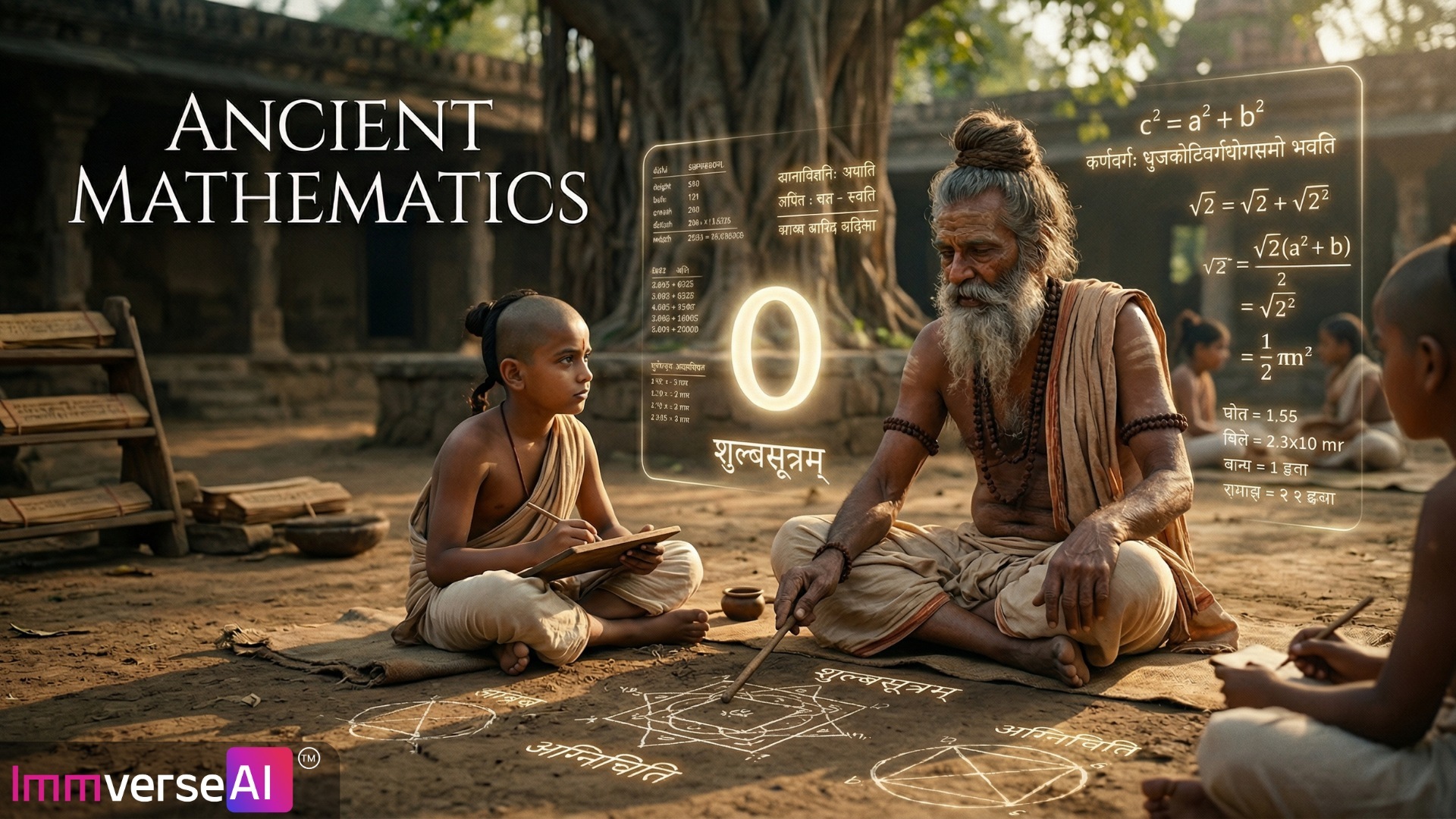
The history of Mathematics is usually written through the lens of a Western perspective. But it was from the inner sanctums of the sacred groves in ancient India where Global calculations truly began. Well before an actual mechanical computer existed, the Rishis of Bharat decoded the entire Universe.
The Ancient Birth of Ganit: A Legacy in Logic
The progression of mathematics (Ganit) from an Indian perspective has always sought out 'Truth'... Our ancestors visualized the Cosmos through the use of Logic and Precision rather than simple calculations.
1. Geometry of the Altars (Sulba Sutras)
The Sulba Sutras, created between 800 and 500 BCE, serve as the earliest mathematical foundations of Indian mathematics because they were written by Vedic scholars Maharishi Baudhayana, Acharya Apastamba, and Acharya Katyayana.
The Rishis also needed to build altars which were appropriate for different kinds of Yajnas, which needed more complex geometric calculations than simple squares, rectangles, circles, etc. This needed not only physical measurements, but also understanding how measurements can be converted into something simpler, and vice versa.
The Three Rishis:
The Theorem of the Square of the Diagonal: What is now known as the Pythagorean Theorem, Maharishi Baudhayana clearly stated that the area created by the diagonal of a rectangle is equal to the sum of the areas created by the two sides of the rectangle.
Circling the Square: They developed algorithms to change a square into a circle of equal area (or vice versa), indicating that they had a sophisticated understanding of the value of π.
Extraction of Square Roots: To build these altars, they required exact lengths. The Sulba Sutras contain a formula for the square root of 2 to five decimal places:
√2 ≈ 1 + ⅓ + 1/3⋅4 - 1/3⋅4.34
The Topics That Shaped Global Math.
The Sulba Sutras have gifted the world many basic ideas, which Ganit GPT is using today to describe its logic:
Geometric Algebra: Using spatial geometry to solve algebraic equations.
Rational Approximations: Dealing with irrational numbers using only a "shulba" (rope).
Fractal Thinking: The construction of the Syena Chiti (Falcon altar) involved using bricks in a pattern, which is a form of fractal geometry, a concept used in AI algorithms.
Maharshi Baudhayana's Sulba Sutras were written centuries before the birth of Pythagoras and contain detailed geometric instructions for constructing Vedic Altars. They are the first documentation (in verses) of what we refer to today as the Pythagorean theorem and signify that while the world was still in early times, India had achieved mastery over spatial dimensions.
Acharya Aryabhata and the Rise of Classical Indian Mathematics
Mathematics became really good with the work of Acharya Aryabhata in the 5th century CE. Aryabhata wrote a book called Aryabhatiya, where he talked about new ideas in arithmetic, algebra, and astronomy.
Aryabhata invented so many good things. He figured out a good approximation of Pi, which shows he understood circular geometry very well. Aryabhata also came up with ways to solve equations in a way, and he looked into ideas that would later be important in trigonometry. He even made tables that helped people calculate where the planets were.
Aryabhata did not just work on math by itself. His work was connected to astronomy and navigation, and calendar calculations. This shows that a long time ago in India, science was about looking at lots of things together.
The Concept of Śūnya (Sunya): A Revolutionary Idea
The Bakshali Manuscript was founded in 1881. Tests showed it is from the 3rd or 4th Century. The Bakhshali Manuscript is a book on birch bark. It has the world's known symbol for zero.
Why It’s Revolutionary:
- The Symbol: Shunya/Zero was represented by an actual “bindu” or dot in the Bakshali manuscript.
- The Bakhshali Manuscript helped people understand small numbers. For example, it showed that 10 and 100 are different because of where the zero's placed. This helped create the system we use to understand numbers today.
- Zero was a thing. Some cultures used spaces to mean nothing. This manuscript treated zero like a real number that you can use in math problems. Zero is also called Śūnya.
People like Acharya Brahmagupta wrote about zero in the 7th century CE. Brahmagupta said how to do arithmetic with zero and negative numbers. This was the start of the way we write numbers today.
The idea of zero changed math around the world. It made it possible to do calculations. Eventually, it helped make computers and digital technology. Aryabhata and the concept of Śūnya are still important in mathematics today.
Algebra, Trigonometry, and Advanced Math Concepts.
The expansion of mathematical knowledge continued with Indian mathematicians for centuries to come. They further refined trigonometric concepts with mathematicians like Maharishi Bhaskaracharya (Bhaskara II), exploring algebraic methods, calculus-like methods, and the use of math for astronomical purposes through their writings.
Advanced techniques for calculating square roots, solving quadratic equations, and considering these relationships geometrically were all developed by Indian mathematicians and influenced math cultures throughout the Middle East, Europe, and Asia.
The Simplicity of Vedic Mathematics.
Lastly, what is unique and incredibly awesome about India's contribution to math is Vedic Mathematics, the system of simple techniques used to effortlessly complete calculations based on ancient mathematics.
Through the use of these techniques, complicated arithmetic operations can be performed easily by using intuitive patterns and fast mental shortcuts. Vedic Mathematics is widely used today for its ability to improve speed in computation, logical thought, and intuitive ability with numbers.
VEDIC MATHEMATICS & MENTAL AGILITY
The ancient techniques of Vedic Mathematics found in our heritage offer shortcuts to solving complicated mathematical problems, including everything from calculating square roots to solving quadratic equations. The various algorithms created early on by our Rishis were developed with maximum efficiency in mind, which is a fundamental principle behind all AI today - techniques that can produce the same result using the least amount of time and energy.
GANIT GPT - ANCIENT WISDOM - MODERN INTERFACE
Ganit GPT works like a calculator but acts as a connection; it will help you find your way through ancient mathematical principles represented in the more modern software, BharatiyaGPT. Ganit GPT answers will utilize both Vedic mental arithmetic and the ancient algorithms used in Lilavati to assist users in their understanding and solution development.
If you're a student who needs to know how to logically arrive at the value of a square root, or a researcher who is trying to further develop your understanding of the concepts found in Aryabhattiya, Ganit GPT will provide usage insights using information processed through the lens of the cultural and intellectual heritage of Bharat.
BharatiyaGPT is not just about GanitGPT; it is part of an initiative to store and protect India’s ancient wisdom by recovering it from manuscripts that have been hidden and forgotten.
For centuries, ancient wisdom in India was primarily stored in palm-leaf manuscripts that were deteriorating with time or in the complex structure of Sanskrit poetry. With BharatiyaGPT, we want to make sure that this knowledge is never lost again.
We are in the process of collecting, digitizing, and creating data sets from thousands of pieces of ancient Indian manuscripts. The goal of this project is not just to translate the text but also to provide the context for the text.
We are using advanced OCR (optical character recognition) technologies to provide easy-to-understand translations of this ancient Indian wisdom to the people of today.
By creating a mechanism for students in large metropolitan areas to ask questions about the Sulba Sutras and receive accurate, historically relevant answers, we are bridging the gap between generations of people who carry the same knowledge within them.
At ImmverseAI, we are not just creating a chatbot; we are creating a repository of the soul of India that will serve as a source of wisdom for future generations. The ancient wisdom of the Rishis will no longer be a remnant of the past but a living and breathing testament to the future through BharatiyaGPT.
The future of Artificial Intelligence has arrived, and it speaks the language of Bharat.
.png)
.png)
.png)